#include <ttauri/exception.hpp>
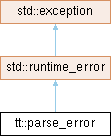
Public Member Functions | |
| template<typename FirstArg , typename... Args> | |
| parse_error (std::string_view fmt, FirstArg const &arg1, Args const &... args) noexcept | |
 Public Member Functions inherited from std::runtime_error Public Member Functions inherited from std::runtime_error | |
| T | runtime_error (T... args) |
| T | what (T... args) |
| Public Member Functions inherited from std::exception | |
| T | what (T... args) |
| T | ~exception (T... args) |
| T | operator= (T... args) |
| T | exception (T... args) |
Detailed Description
Exception thrown during parsing on an error.
This exception is often thrown due to an error in the syntax in both text and binary files.
The what-string should start with the location of the error in the file followed with ": " and the error message. The what-string may be shown to the user, when the parser was working on user supplied files.
The location for a text file will be: a path followed by line_nr (starting at line 1) and column_nr (starting at column 1). The location for a binary: a path followed by an optional chunk names, followed by a byte number within the chunk.
If there are nested errors, such as an error in an included file, then the what-string may be multiple-lines, where the nested error appears later in the what-string.
The documentation for this class was generated from the following file:
- hikogui/src/ttauri/exception.hpp