#include <hikogui/widgets/scroll_widget.hpp>
Public Types | |
| using | super = widget |
| using | aperture_type = scroll_aperture_widget<prefix> |
| using | horizontal_bar_type = scroll_bar_widget<axis::horizontal, prefix> |
| using | vertical_bar_type = scroll_bar_widget<axis::vertical, prefix> |
 Public Types inherited from hi::v1::widget Public Types inherited from hi::v1::widget | |
| using | callback_token = notifier<void()>::callback_token |
| using | awaiter_type = notifier<void()>::awaiter_type |
Public Member Functions | |
| scroll_widget (widget *parent) noexcept | |
| Constructs an empty scroll widget. | |
| template<typename Widget , typename... Args> | |
| Widget & | make_widget (Args &&...args) noexcept |
| Add a content widget directly to this scroll widget. | |
| Public Member Functions inherited from hi::v1::widget | |
| widget (widget *parent) noexcept | |
| widget (widget const &)=delete | |
| widget (widget &&)=delete | |
| widget & | operator= (widget &&)=delete |
| widget & | operator= (widget const &)=delete |
| generator< widget & > | children (bool include_invisible) noexcept |
| virtual hitbox | hitbox_test_from_parent (point2i position) const noexcept |
| Call hitbox_test from a parent widget. | |
| virtual hitbox | hitbox_test_from_parent (point2i position, hitbox sibling_hitbox) const noexcept |
| Call hitbox_test from a parent widget. | |
| virtual bool | accepts_keyboard_focus (keyboard_focus_group group) const noexcept |
| Check if the widget will accept keyboard focus. | |
| void | reset_layout (gfx_surface *new_surface, float new_scale) noexcept |
| Reset the layout. | |
| virtual sub_theme_selector_type | sub_theme_selector () const noexcept |
| virtual bool | process_event (gui_event const &event) const noexcept |
| virtual void | request_redraw () const noexcept |
| Request the widget to be redrawn on the next frame. | |
| virtual bool | handle_event (gui_event const &event) noexcept |
| Handle command. | |
| virtual bool | handle_event_recursive (gui_event const &event, std::vector< widget_id > const &reject_list=std::vector< widget_id >{}) noexcept |
| Handle command recursive. | |
| virtual widget_id | find_next_widget (widget_id current_keyboard_widget, keyboard_focus_group group, keyboard_focus_direction direction) const noexcept |
| Find the next widget that handles keyboard focus. | |
| widget_id | find_first_widget (keyboard_focus_group group) const noexcept |
| widget_id | find_last_widget (keyboard_focus_group group) const noexcept |
| bool | is_first (keyboard_focus_group group) const noexcept |
| bool | is_last (keyboard_focus_group group) const noexcept |
| virtual void | scroll_to_show (hi::aarectanglei rectangle) noexcept |
| Scroll to show the given rectangle on the window. | |
| std::vector< widget_id > | parent_chain () const noexcept |
| Get a list of parents of a given widget. | |
| virtual bool | is_tab_button () const noexcept |
| Check if this widget is a tab-button. | |
| template<forward_of< void()> Callback> | |
| callback_token | subscribe (Callback &&callback, callback_flags flags=callback_flags::synchronous) const noexcept |
| awaiter_type | operator co_await () const noexcept |
Static Public Attributes | |
| static constexpr auto | prefix = Name / "scroll" |
| static constexpr hi::axis | axis = Axis |
Additional Inherited Members | |
| Data Fields inherited from hi::v1::widget | |
| widget_id | id = {} |
| The numeric identifier of a widget. | |
| widget * | parent = nullptr |
| Pointer to the parent widget. | |
| gfx_surface * | surface = nullptr |
| The surface this widget is drawn on. | |
| observer< widget_mode > | mode = widget_mode::enabled |
| The widget mode. | |
| observer< bool > | hover = false |
| Mouse cursor is hovering over the widget. | |
| observer< bool > | clicked = false |
| The widget is being clicked by the mouse. | |
| observer< bool > | focus = false |
| The widget has keyboard focus. | |
| observer< widget_state > | state = widget_state::off |
| The state of the widget. | |
| size_t | semantic_layer = 0_uz |
| The draw layer of the widget. | |
| observer< extent2i > | minimum = extent2i{} |
| The minimum size this widget is allowed to be. | |
| observer< extent2i > | maximum = extent2i::large() |
| The maximum size this widget is allowed to be. | |
| widget_layout | layout |
Detailed Description
class hi::v1::scroll_widget< Axis, Name >
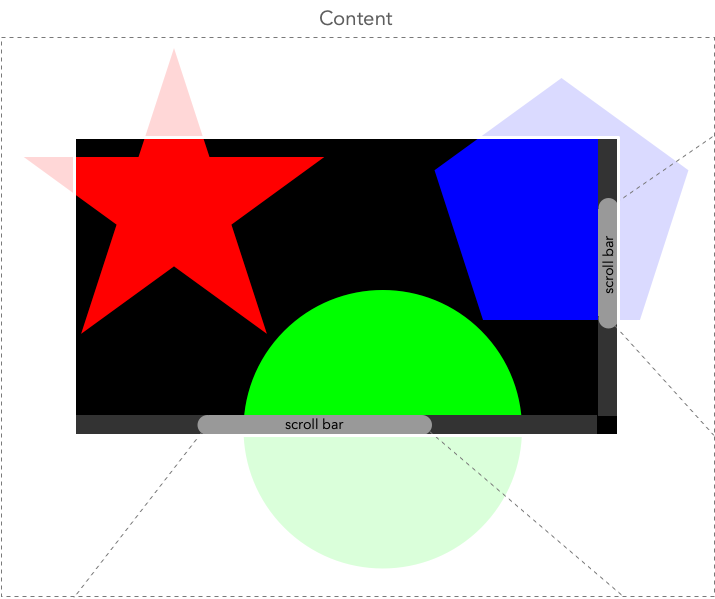
The scroll widget allows a content widget to be shown in less space than is required.
The user can then show the part of the content widget by using the scroll-bar widgets which are provided by the scroll widget.
The size of the scroll widget is based on the widget::minimum_size(), widget::preferred_size() and widget::maximum_size() of the content widget together with the space needed for the scrollbars.
In the directions that are allowed for scrolling the minimum size of the scroll widget is adjusted to be much smaller, up to the smallest size of the scroll-bar widget in that direction.
Scroll-bars are automatically added when the actual size of the scroll widget is smaller than the content, this will happen even if the template parameters given did not allow scrolling in that direction. This is useful behavior when the scroll widget is part of an overlay widget which was unable to size to the minimum size requested.
- Template Parameters
-
Axis the axis that the content may be scrolled. Allowed values are axis::horizontal,axis::verticaloraxis::both.
Constructor & Destructor Documentation
◆ scroll_widget()
|
inlinenoexcept |
Constructs an empty scroll widget.
- Parameters
-
parent The parent widget.
Member Function Documentation
◆ make_widget()
|
inlinenoexcept |
Add a content widget directly to this scroll widget.
This widget is added as the content widget.
- Precondition
- No content widgets have been added before.
- Template Parameters
-
Widget The type of the widget to be constructed.
- Parameters
-
args The arguments passed to the constructor of the widget.
- Returns
- A reference to the widget that was created.
The documentation for this class was generated from the following file:
- hikogui/src/hikogui/widgets/scroll_widget.hpp