#include <hikogui/widgets/radio_menu_button_widget.hpp>
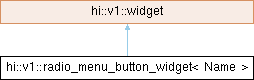
Inheritance diagram for hi::v1::radio_menu_button_widget< Name >:
Public Types | |
| using | super = widget |
| using | delegate_type = typename radio_button_delegate |
 Public Types inherited from hi::v1::widget Public Types inherited from hi::v1::widget | |
| using | callback_token = notifier<void()>::callback_token |
| using | awaiter_type = notifier<void()>::awaiter_type |
Public Member Functions | |
| radio_menu_button_widget (widget *parent, std::shared_ptr< delegate_type > delegate, button_widget_attribute auto &&...attributes) noexcept | |
| Construct a menu button widget. | |
| template<different_from< std::shared_ptr< delegate_type > > Value, forward_of< observer< observer_decay_t< Value > > > OnValue, button_widget_attribute... Attributes> requires requires { make_default_radio_button_delegate(hi_forward(value), hi_forward(on_value)); } | |
| radio_menu_button_widget (widget *parent, Value &&value, OnValue &&on_value, Attributes &&...attributes) noexcept | |
| Construct a menu button widget with a default button delegate. | |
| Public Member Functions inherited from hi::v1::widget | |
| widget (widget *parent) noexcept | |
| widget (widget const &)=delete | |
| widget (widget &&)=delete | |
| widget & | operator= (widget &&)=delete |
| widget & | operator= (widget const &)=delete |
| generator< widget & > | children (bool include_invisible) noexcept |
| virtual hitbox | hitbox_test_from_parent (point2 position) const noexcept |
| Call hitbox_test from a parent widget. | |
| virtual hitbox | hitbox_test_from_parent (point2 position, hitbox sibling_hitbox) const noexcept |
| Call hitbox_test from a parent widget. | |
| void | reset_layout (gfx_surface *new_surface, float new_scale) noexcept |
| Reset the layout. | |
| virtual void | layout () noexcept |
| virtual sub_theme_selector_type | sub_theme_selector () const noexcept |
| virtual bool | process_event (gui_event const &event) const noexcept |
| virtual void | request_redraw () const noexcept |
| Request the widget to be redrawn on the next frame. | |
| virtual bool | handle_event_recursive (gui_event const &event, std::vector< widget_id > const &reject_list=std::vector< widget_id >{}) noexcept |
| Handle command recursive. | |
| virtual widget_id | find_next_widget (widget_id current_keyboard_widget, keyboard_focus_group group, keyboard_focus_direction direction) const noexcept |
| Find the next widget that handles keyboard focus. | |
| widget_id | find_first_widget (keyboard_focus_group group) const noexcept |
| widget_id | find_last_widget (keyboard_focus_group group) const noexcept |
| bool | is_first (keyboard_focus_group group) const noexcept |
| bool | is_last (keyboard_focus_group group) const noexcept |
| virtual void | scroll_to_show (hi::aarectangle rectangle) noexcept |
| Scroll to show the given rectangle on the window. | |
| std::vector< widget_id > | parent_chain () const noexcept |
| Get a list of parents of a given widget. | |
| virtual bool | is_tab_button () const noexcept |
| Check if this widget is a tab-button. | |
| template<forward_of< void()> Callback> | |
| callback_token | subscribe (Callback &&callback, callback_flags flags=callback_flags::synchronous) const noexcept |
| awaiter_type | operator co_await () const noexcept |
Static Public Attributes | |
| static constexpr auto | prefix = Name / "radio-menu" |
Additional Inherited Members | |
| Data Fields inherited from hi::v1::widget | |
| widget_id | id = {} |
| The numeric identifier of a widget. | |
| widget * | parent = nullptr |
| Pointer to the parent widget. | |
| gfx_surface * | surface = nullptr |
| The surface this widget is drawn on. | |
| observer< widget_mode > | mode = widget_mode::enabled |
| The widget mode. | |
| observer< bool > | hover = false |
| Mouse cursor is hovering over the widget. | |
| observer< bool > | clicked = false |
| The widget is being clicked by the mouse. | |
| observer< bool > | focus = false |
| The widget has keyboard focus. | |
| observer< widget_state > | state = widget_state::off |
| The state of the widget. | |
| size_t | semantic_layer = 0_uz |
| The draw layer of the widget. | |
| grid_cell | cell |
Detailed Description
template<fixed_string Name = "">
class hi::v1::radio_menu_button_widget< Name >
class hi::v1::radio_menu_button_widget< Name >
A button that is part of a menu.
A menu-button has two different states with different visual representation:
- on: The menu button shows a check mark next to the label.
- off: The menu button shows just the label.
Each time a user activates the menu-button it switches its state to 'on'. Most menus will close the menu after the menu button was activated.
A menu button cannot itself switch state to 'off', this state may be caused by external factors. The canonical example is another menu button in a set, which is configured with a different on_value.
Constructor & Destructor Documentation
◆ radio_menu_button_widget() [1/2]
template<fixed_string Name = "">
|
inlinenoexcept |
Construct a menu button widget.
- Parameters
-
parent The parent widget that owns this menu button widget. delegate The delegate to use to manage the state of the menu button. attributes Different attributes used to configure the label's on the menu button: a label,alignmentortext_theme. If one label is passed it will be shown in all states. If two labels are passed the first label is shown in on-state and the second for off-state.
◆ radio_menu_button_widget() [2/2]
template<fixed_string Name = "">
template<different_from< std::shared_ptr< delegate_type > > Value, forward_of< observer< observer_decay_t< Value > > > OnValue, button_widget_attribute... Attributes>
requires requires { make_default_radio_button_delegate(hi_forward(value), hi_forward(on_value)); }
requires requires { make_default_radio_button_delegate(hi_forward(value), hi_forward(on_value)); }
|
inlinenoexcept |
Construct a menu button widget with a default button delegate.
- Parameters
-
parent The parent widget that owns this menu button widget. value The value or observervalue which represents the state of the menu button.on_value An optional on-value. This value is used to determine which value yields an 'on' state. attributes Different attributes used to configure the label's on the menu button: a label,alignmentortext_theme. If one label is passed it will be shown in all states. If two labels are passed the first label is shown in on-state and the second for off-state.
The documentation for this class was generated from the following file:
- hikogui/src/hikogui/widgets/radio_menu_button_widget.hpp