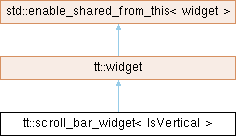
Public Types | |
| using | super = widget |
Public Member Functions | |
| template<typename Content , typename Aperture , typename Offset > | |
| scroll_bar_widget (gui_window &window, std::shared_ptr< abstract_container_widget > parent, Content &&content, Aperture &&aperture, Offset &&offset) noexcept | |
| bool | update_constraints (hires_utc_clock::time_point display_time_point, bool need_reconstrain) noexcept override |
| Update the constraints of the widget. | |
| void | update_layout (hires_utc_clock::time_point display_time_point, bool need_layout) noexcept override |
| Update the internal layout of the widget. | |
| void | draw (draw_context context, hires_utc_clock::time_point display_time_point) noexcept override |
| Draw the widget. | |
| hit_box | hitbox_test (point2 position) const noexcept override |
| Find the widget that is under the mouse cursor. | |
| bool | handle_event (mouse_event const &event) noexcept |
| bool | accepts_keyboard_focus (keyboard_focus_group group) const noexcept override |
| Check if the widget will accept keyboard focus. | |
| bool | visible () const noexcept |
| Is the scrollbar visible. | |
| color | background_color () const noexcept override |
| color | foreground_color () const noexcept override |
 Public Member Functions inherited from tt::widget Public Member Functions inherited from tt::widget | |
| widget (gui_window &window, std::shared_ptr< abstract_container_widget > parent) noexcept | |
| widget (const widget &)=delete | |
| widget & | operator= (const widget &)=delete |
| widget (widget &&)=delete | |
| widget & | operator= (widget &&)=delete |
| virtual void | init () noexcept |
| Should be called right after allocating and constructing a widget. | |
| float | margin () const noexcept |
| Get the margin around the Widget. | |
| float | draw_layer () const noexcept |
| The first drawing layer of the widget. | |
| int | logical_layer () const noexcept |
| The logical layer of the widget. | |
| int | semantic_layer () const noexcept |
| The semantic layer of the widget. | |
| ranged_int< 3 > | width_resistance () const noexcept |
| Get the resistance in width. | |
| ranged_int< 3 > | height_resistance () const noexcept |
| Get the resistance in height. | |
| interval_extent2 | preferred_size () const noexcept |
| Get the size-range of the widget. | |
| void | set_layout_parameters (geo::transformer auto const &local_to_parent, extent2 size, aarectangle const &clipping_rectangle) noexcept |
| Set the location and size of the widget inside the window. | |
| void | set_layout_parameters_from_parent (aarectangle child_rectangle, aarectangle parent_clipping_rectangle, float draw_layer_delta) noexcept |
| void | set_layout_parameters_from_parent (aarectangle child_rectangle) noexcept |
| matrix3 | parent_to_local () const noexcept |
| matrix3 | local_to_parent () const noexcept |
| matrix3 | window_to_local () const noexcept |
| matrix3 | local_to_window () const noexcept |
| extent2 | size () const noexcept |
| float | width () const noexcept |
| float | height () const noexcept |
| aarectangle | rectangle () const noexcept |
| Get the rectangle in local coordinates. | |
| virtual float | base_line () const noexcept |
| Return the base-line where the text should be located. | |
| aarectangle | clipping_rectangle () const noexcept |
| gui_device * | device () const noexcept |
| virtual color | focus_color () const noexcept |
| virtual color | accent_color () const noexcept |
| virtual color | label_color () const noexcept |
| virtual void | request_redraw () const noexcept |
| virtual bool | handle_event (command command) noexcept |
| Handle command. | |
| virtual bool | handle_event (std::vector< command > const &commands) noexcept |
| virtual bool | handle_command_recursive (command command, std::vector< std::shared_ptr< widget > > const &reject_list) noexcept |
| Handle command recursive. | |
| virtual bool | handle_event (keyboard_event const &event) noexcept |
| Handle keyboard event. | |
| virtual std::shared_ptr< widget > | find_next_widget (std::shared_ptr< widget > const ¤t_keyboard_widget, keyboard_focus_group group, keyboard_focus_direction direction) const noexcept |
| Find the next widget that handles keyboard focus. | |
| std::shared_ptr< abstract_container_widget const > | shared_parent () const noexcept |
| Get a shared_ptr to the parent. | |
| std::shared_ptr< abstract_container_widget > | shared_parent () noexcept |
| Get a shared_ptr to the parent. | |
| abstract_container_widget const & | parent () const noexcept |
| Get a reference to the parent. | |
| abstract_container_widget & | parent () noexcept |
| Get a reference to the parent. | |
| bool | is_first (keyboard_focus_group group) const noexcept |
| Is this widget the first widget in the parent container. | |
| bool | is_last (keyboard_focus_group group) const noexcept |
| Is this widget the last widget in the parent container. | |
| Public Member Functions inherited from std::enable_shared_from_this< widget > | |
| T | enable_shared_from_this (T... args) |
| T | operator= (T... args) |
| T | shared_from_this (T... args) |
| T | ~enable_shared_from_this (T... args) |
Static Public Attributes | |
| static constexpr bool | is_vertical = IsVertical |
Additional Inherited Members | |
| Static Public Member Functions inherited from tt::widget | |
| static std::vector< std::shared_ptr< widget > > | parent_chain (std::shared_ptr< tt::widget > const &child_widget) noexcept |
| Get a list of parents of a given widget. | |
| Data Fields inherited from tt::widget | |
| gui_window & | window |
| Convenient reference to the Window. | |
| observable< bool > | enabled = true |
| The widget is enabled. | |
Member Function Documentation
◆ accepts_keyboard_focus()
|
inlineoverridevirtualnoexcept |
Check if the widget will accept keyboard focus.
- Precondition
mutexmust be locked by current thread.
Reimplemented from tt::widget.
◆ background_color()
|
inlineoverridevirtualnoexcept |
Reimplemented from tt::widget.
◆ draw()
|
inlineoverridevirtualnoexcept |
Draw the widget.
This function is called by the window (optionally) on every frame. It should recursively call this function on every visible child. This function is only called when updateLayout() has returned true.
The overriding function should call the base class's draw(), the place where the call this function will determine the order of the vertices into each buffer. This is important when needing to do the painters algorithm for alpha-compositing. However the pipelines are always drawn in the same order.
- Precondition
mutexmust be locked by current thread.
- Parameters
-
context The context to where the widget will draw. display_time_point The time point when the widget will be shown on the screen.
Reimplemented from tt::widget.
◆ foreground_color()
|
inlineoverridevirtualnoexcept |
Reimplemented from tt::widget.
◆ handle_event()
|
inlinevirtualnoexcept |
Handle mouse event. Called by the operating system to show the position and button state of the mouse. This is called very often so it must be made efficient. This function is also used to determine the mouse cursor.
In most cased overriding methods should call the super's handle_event() at the start of the function, to detect hover.
When this method does not handle the event the window will call handle_event() on the widget's parent.
- Parameters
-
event The mouse event, positions are in window coordinates.
- Returns
- If this widget has handled the mouse event.
Reimplemented from tt::widget.
◆ hitbox_test()
|
inlineoverridevirtualnoexcept |
Find the widget that is under the mouse cursor.
This function will recursively test with visual child widgets, when widgets overlap on the screen the hitbox object with the highest elevation is returned.
- Parameters
-
position The coordinate of the mouse local to the widget.
- Returns
- A hit_box object with the cursor-type and a reference to the widget.
Reimplemented from tt::widget.
◆ update_constraints()
|
inlineoverridevirtualnoexcept |
Update the constraints of the widget.
This function is called on each vertical sync, even if no drawing is to be done. It should recursively call updateConstraints() on each of the visible children, so they get a chance to update.
This function may be used for expensive calculations, such as text-shaping, which should only be done when the data changes. Because this function is called on every vertical sync it should cache these calculations.
Subclasses should call updateConstraints() on its base-class to check if the constraints where changed. Widget::update_constraints() will check if requestConstraints was set. Container::update_constraints() will check if any of the children changed constraints.
If the container, due to a change in constraints, wants the window to resize to the minimum size it should set window.requestResize to true.
This function will change what is returned by preferred_size() and preferred_base_line().
- Precondition
mutexmust be locked by current thread.
- Parameters
-
display_time_point The time point when the widget will be shown on the screen. need_reconstrain Force the widget to re-constrain.
- Returns
- True if its or any children's constraints has changed.
Reimplemented from tt::widget.
◆ update_layout()
|
inlineoverridevirtualnoexcept |
Update the internal layout of the widget.
This function is called on each vertical sync, even if no drawing is to be done. It should recursively call updateLayout() on each of the visible children, so they get a chance to update.
This function may be used for expensive calculations, such as geometry calculations, which should only be done when the data or sizes change. Because this function is called on every vertical sync it should cache these calculations.
This function will likely call set_layout_parameters() on its children.
Subclasses should call updateLayout() on its children, call updateLayout() on its base class with forceLayout argument to the result of layoutRequest.exchange(false).
- Precondition
mutexmust be locked by current thread.
- Parameters
-
display_time_point The time point when the widget will be shown on the screen. need_layout Force the widget to layout
Reimplemented from tt::widget.
◆ visible()
|
inlinenoexcept |
Is the scrollbar visible.
When the content is the same size as the scroll-view then the scrollbar becomes invisible.
The documentation for this class was generated from the following file:
- hikogui/src/ttauri/widgets/scroll_bar_widget.hpp